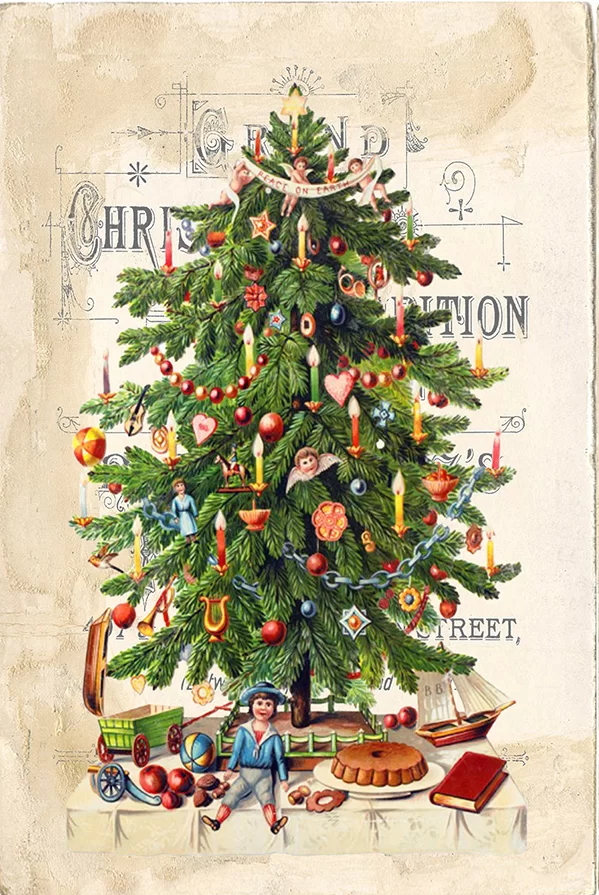
“Christmas at the farm…”

Nearly fifty years ago I wrote a Christmas story for my column Antiquer’s Notebook, which appeared every Friday in the Morristown, New Jersey newspaper The Daily Record. Last night I started thinking about where that column was. I’d kept copies of all my old columns, but for some reason this one had disappeared. If only I could find it again….

But the boxes full of my old clippings were packed away in a cold crawl space that was difficult to get to. If I’d published these articles when there was an internet, finding it would be a simple matter. However, back in 1977, when I wrote this story, the internet was still being developed. So there was no way to retrieve it electronically. Or was there?

This morning, over coffee, I started searching on my iPhone. As soon as I put in “Daily Record Morristown NJ Archives,” the site Newspapers.com came up, announcing that any article article from 1974 on could be located. What?! Maybe I could find it after all!

After clicking on the website and logging in for a free 14-day trial, I entered into the search bars “The Daily Record,” “Antiquer’s Notebook,” and the dates “1977-78.” Voila! Over 100 notifications came up – they did, indeed, have copies of all my columns! Now I just had to figure out which one it was.

After sharing this excitement with Buzz, I went to my computer and began experimenting on the Newspapers.com site, finally realizing that I could narrow my search by putting in “Friday” and “December 1977.” But maybe it was 1978, I couldn’t remember. Going through Fridays in 1977, I suddenly came upon it: December 23, 1977. Hallelujah! – there it was!

“I found it!” I cried out to Buzz.

“Great!” he said, coming over to stand behind me, looking at the image I’d found. “Read it to me.” And so I began:

“It was our only Christmas at the farm. Earlysville, Virginia, December 1975.

The oldest part of the house, built in the late 1700s, had been a log cabin, one large room with a stone fireplace, sleeping loft and lean-to kitchen. Later more rooms were added, two additional fireplaces, a porch and stairways to the upper floor. The house had settled over the years, causing doorways, mantels, and window frames to tilt every which way; stoops were worn with decades of use, the once exposed log beams had been covered with beaded wooden panelling.

We filled it with the country antiques we’d collected – grained chests and red painted cupboards, pierced tin pie safes, ladder back rockers, starburst quilts and hog scraper candlesticks. When early morning sun poured into the keeping room windows, we always had the feeling, somehow, that the old house approved.

From the kitchen windows we had a view of the Blue Ridge Mountains, which loomed in a distant purplish haze even on the clearest of days. Our back yard was fenced in to keep out the farmer’s cows, and beyond were fields of palest gold meadow grass, a lake that glittered in the winter light, woodland sedged with pines.

Snow fell before Christmas in soft, drifting flakes so large you could see, if you tried, each delicate intricate pattern. There was a green-gathering party that day at the Tevendales, our nearest neighbors, and we’d all bundled up warmly, excited about the prospect of a festive day’s outing and the unexpected gift of white.

With the others we climbed aboard field wagons and, tractor-drawn, headed toward the woods. There we pulled long tendrils of running cedar from beneath the snow, cut down branches of spruce and pine, and then circled back toward our place, where 30-foot holly trees supplied enough bright red berries and shiny green leaves to festoon every house in the countryside.

Next day, we three struck out across the meadow, toward the woods again, for our tree. We found it nestled into a hillside, a perfectly shaped fir, just the right size for our low-ceilinged keeping room.

It made a path in the snow as we dragged it exuberantly toward the house, past the lake and the old stone-walled cemetery on the hillside, where small gray markers gave witness to inhabitants of other years, the Austin family, who had homesteaded here in the 1800s.

Once inside it was only fitting that the tree be decorated as of old with strings of cranberries and popcorn, paper cutouts of stars and sleighs, peppermint sticks and cookies cut from handmade tin shapes. Cats and reindeer, roosters and running horses.

With a pine wreath above the mantel, holly and running cedar strewn about the doorways, and our tree – lit with tiny lights instead of candles, our only modern concession – we had only the presents to wrap and we were ready.

Our cats sniffed the tree curiously. Cautiously we wired it to the wall in several strategic places, averting possible catastrophe.

On Christmas Eve, with a roast in the oven and the sun glowing pink-gold over the mountains, we set out for a walk to watch the last fading colors of the sky. The air had a gray chill, promising more snow that evening, and the meadow grass crunched underfoot as we held hands and began singing, loudly, every Christmas carol we could remember the words to.

The cows, startled, began coming up out of the creek bed. Edging nearer, sniffing the air and pawing at the frozen ground, they soon formed a ring around us as we continued to sing. “Oh come, all ye faithful, joyful and triumphant, oh come ye, oh come ye….”

Their great dark eyes seemed to grow even wider as they watched us, crooking their ears and swishing their tails furiously. Our favorite brown and white cow, the only one brave enough to let us pet him, stepped forward and nuzzled his nose, tentatively, toward Keri’s pocket. Suddenly we realized they were more hungry than curious. The farmer who rented these fields hadn’t been by for a day or two, we remembered. What they needed on this Christmas Eve, besides a chorus of carols, was simply a little sustenance.

Back at the house we gathered every piece of day-old bread we could find, stuffing our pockets full and basketing an array of crusts in our up-turned coat flaps. Heading back into the fields again, where the cows waited patiently under a sky patterned with stars, we attempted to feed at least one morsel to every beast. When all we had was gone, we started back toward the house, the cows following us as far as the gate and then standing, lowing, as we closed and latched it behind us.

Hours later, after our roast beef dinner, after a warming fire and the Christmas story and a round of hand-dipped chocolates, the lights suddenly dimmed for a moment, rose up again, and went to black – Christmas tree and all. Wind moaned around the eves and a rattling noise began on the tin roof.

Taking up candles we peered out the windows at the hard sleet pelting against the glass. We tried our phone – dead, of course, for this was the country and even a simple summer storm could halt the lines.

But we had candles and the warmth from our fireplace, and plenty of food in the larder.

We lit a few oil lamps and started singing again.”

I could barely get out the last line – the emotion of returning to a time fifty years ago was too overwhelming. Buzz and I just looked at each other. “That was a beautiful Christmas,” he said finally. All I could do was nod.

Building the ADU: A Year Later…

Nearly a year ago I ended my last post on the topic of Building the ADU with “The next step: pouring the foundation.” And then, throughout the rest of 2024 and into 2025 – silence here, although I did keep a daily stream of building updates with photos on Facebook . The problem there, now, is that to find the beginning or follow the sequence of what happened requires scrolling down through dozens of posts. I want to have some kind of easily obtainable record for our family to look at – or that others who are interested in the building process can check out. So: back to this blog.

Continue reading “Building the ADU: A Year Later…”

Building the ADU: preparing the site

It began at the end of June with the arrival of heavy machinery needed for digging the foundation. But first, a number of trees had to be taken down that were too close to the proposed “new wing,” otherwise known as an Accessory Dwelling Unit (ADU). You can find out why we needed to add onto our house here. A daily blow by blow with videos can be found on my Facebook page here.

Continue reading “Building the ADU: preparing the site”

Finding Cathrineholm

One person’s giveaway is another person’s treasure.

Recently friends of mine were cleaning out their closets and garage and getting rid of items they no longer needed or wanted. Knowing I had an Etsy shop, they asked if I’d like an enamelware bowl to sell. As soon as I saw it, I knew what it was: a Cathrineholm lotus bowl in avocado and white.

Continue reading “Finding Cathrineholm”

The HELOC miracle

It took three months to get our HELOC (Home Equity Line of Credit) for building the addition to our house, otherwise known as an Accessory Dwelling Unit (ADU – see my last post). The whole process was a roller coaster. Without the thrills – that is, until the last day when the miracle happened.

Continue reading “The HELOC miracle”

Another building project: The ADU

We thought we were done building, that this would be our “forever house.” Never say never. Or plan too far into the future. Life has a way of taking curious and unexpected courses.

Last year our daughter, son-in-law, and two youngest grandchildren decided to return to New Hampshire after several years of living in Vermont. They moved in with us “temporarily” while looking for a house to rent. After months of searching, however, they couldn’t find anything suitable. There’s a severe shortage of houses for rent right now, a situation that appears to be occurring throughout the country.

Continue reading “Another building project: The ADU”

Lectin-free cooking: beginnings

I didn’t begin the right way. When I headed off on my lectin-free cooking adventure, I hadn’t read Dr. Steven Gundry’s “The Plant Paradox.” If I had, I would have discovered his three-phased approach to this diet.

Instead, I simply found his “Yes” and “No” lists, copied and carried them with me to the grocery store and used them to choose my produce. Then I decided what to make for breakfast, lunch, and dinner. Advice: read “The Plant Paradox” first.

Continue reading “Lectin-free cooking: beginnings”

The lectin-free experiment, part 2

It’s been about nine months now since we started this experiment, and several months since my last post about how and why we began, but after eating this new way for most of the year, I can say with certainty that we’ll never go back to “the way it was.”

Not that this new diet doesn’t come with its drawbacks, most notably in the area of eating out, whether at restaurants or at the homes of friends, which can be challenging. Being “gluten free” had its challenges, too, such as the lure of French or Italian baguettes and “real” pasta (in which case I usually indulged and simply ached in my joints for a few days afterwards), but being “lectin free” means, in addition, trying to avoid dishes containing ingredients such as white potatoes, tomatoes, eggplants, cucumbers, peppers, and other potential gut disruptors.

Continue reading “The lectin-free experiment, part 2”

The lectin-free experiment

Something was wrong. I was eating a totally organic, gluten-free diet of fresh fruits, vegetables, free-range chicken, and wild caught fish. No fast foods, no packaged foods. I made almost everything from scratch. But after meals, I often was bloated. Why? Did I have irritable bowel syndrome? Or “leaky gut”? Bloating would indicate one of those.

So I started poking around the internet, investigating both IBS and leaky gut and reading articles. I didn’t “check with my doctor,” as my own experience told me that all roads starting from that source inevitably lead, after multiple tests, to one or more pharmaceutical drugs – something I definitely wanted to avoid. I didn’t want to put a band-aid on my situation, but find out what was causing it.

Continue reading “The lectin-free experiment”

The pursuit of health, part 2

In 1962 Rachel Carson published her book “Silent Spring,” which detailed the effects of DDT and other pesticides on wildlife, the natural environment, and humans. Many years after its publication I read that book and began wondering if some of my health problems were due to the widespread use of these pesticides in conventional farming.

Becoming interested in the foods we were consuming led me to Adele Davis, now considered the most famous nutritionist in the early to mid-20th century. Her books praising the value of natural foods and criticizing the diet of the average American include “Let’s Cook it Right” (1947), “Let’s Have Healthy Children” (1951), “Let’s Eat Right to Keep Fit” (1954), and “Let’s Get Well” (1965).

Continue reading “The pursuit of health, part 2”